Search engines are changing. Users increasingly turn to ChatGPT, Google AI Overviews, and Google AI Mode to get direct answers, compare solutions, research products, and choose companies. Instead of browsing dozens of websites, someone can begin their research with a single question to an AI-powered search system.
For businesses, this represents a shift in the traditional customer journey. A potential customer may first discover a brand through an AI-generated answer rather than a conventional search results page.
Content optimization for AI search helps websites adapt to these new search experiences. It focuses on making information accessible to search systems, improving content quality, organizing pages more effectively, and increasing opportunities for brands to appear in relevant AI-powered search results.
However, optimizing content for AI search in 2027 involves more than adding keywords, structured data, or FAQ sections. Sustainable results require a comprehensive strategy combining technical SEO, expert content, brand authority, topical relevance, and performance measurement.
In this guide, we explain how to optimize content for AI search, which mistakes can limit website visibility, and what to check before publishing.
What Is Content Optimization for AI Search?
Content optimization for AI search is the process of preparing website information to be discovered, understood, and potentially used by search engines with generative AI capabilities.
Unlike an approach focused exclusively on search rankings, AI search optimization considers additional ways people interact with online information.
For example, a potential customer might ask ChatGPT:
“Which tools can help track brand visibility in AI search?”
Or search Google for:
“How do I choose an SEO agency for international growth?”
An AI-powered search system may generate a response by combining information from several sources. Depending on the platform and the specific query, users may see explanations, recommendations, comparisons, and links to additional resources.
The goal for businesses is to create content that genuinely helps answer these questions.
AI SEO, GEO, and AEO: What’s the Difference?
Several terms are commonly used to describe optimization for AI-powered search.
AI SEO (AI Search Optimization) is a broad term describing search engine optimization strategies that account for generative AI technologies.
GEO (Generative Engine Optimization) focuses on improving brand and content visibility within generative search systems.
AEO (Answer Engine Optimization) focuses on optimizing information for platforms that provide direct answers to user questions.
These concepts overlap significantly. Their shared objectives include improving content accessibility, strengthening information structure, building source credibility, and measuring search visibility.
For most businesses, choosing exclusively between GEO and AEO is unnecessary. A more effective approach is to treat them as interconnected components of a comprehensive organic search strategy.
How Is AI Search Different From Traditional SEO?
Traditional search engine optimization aims to improve website visibility in organic search results. Performance is typically measured through rankings, impressions, clicks, organic traffic, and conversions.
AI-powered search introduces additional ways for users to discover and interact with content.
Instead of simply displaying a list of relevant webpages, search systems can generate detailed responses, explain complex topics, compare solutions, and incorporate information from external sources.
As a result, websites may gain additional visibility through citations, brand mentions, and links included in AI-generated answers.
However, traditional SEO remains essential. Technical accessibility, page relevance, content quality, and internal linking continue to play important roles in search visibility.
The primary difference is not a complete replacement of existing optimization principles. It is an expansion of what businesses need to optimize for.
Companies should now consider not only:
“How can we rank higher in Google?”
But also:
“How useful is our website’s information for answering a specific question through AI-powered search?”
How AI Search Engines Find and Use Content
To understand how AI search optimization works, it is helpful to examine the general process through which generative search systems discover and use information.
Although platforms differ technologically, the process can be simplified into four stages.
1. Content Discovery
Search engines and related systems discover accessible webpages, follow links, review sitemaps, and process other discovery signals.
If a webpage is blocked from relevant search crawlers, requires authentication, or contains serious technical errors, its discovery and potential use may be limited.
2. Information Retrieval
When a user submits a query, an AI-powered search system may retrieve documents and information passages relevant to that request.
For example, a question about SEO pricing may benefit from pages explaining pricing models, service packages, and practical budget examples.
3. Information Analysis and Interpretation
Retrieved information is analyzed in relation to the user’s question and the available context.
Content is particularly useful when it provides clear explanations, verifiable facts, and enough context to distinguish general statements from specific recommendations.
4. Answer Generation
The system generates a response. Depending on the platform, search mode, and query, it may include source links, citations, or brand mentions.
It is important to understand that this four-stage description is a simplified model. Different AI search platforms use their own methods for retrieving information, processing content, and selecting sources.
Therefore, no universal technique can guarantee that a website will appear in the answers of every AI search engine.
Why High-Quality Content May Not Appear in AI Search Results
Even a well-written article is not guaranteed to be selected as a source for an AI-generated answer.
Several factors may affect its visibility, including technical limitations, insufficient query relevance, competition, and platform-specific retrieval mechanisms.
Let’s examine the most common issues.
Poor Content Structure
Imagine a several-thousand-word article with almost no subheadings, where important definitions are buried inside long paragraphs.
Readers struggle to find specific answers, and the page becomes less convenient for navigating individual topics.
A logical structure can improve the experience:
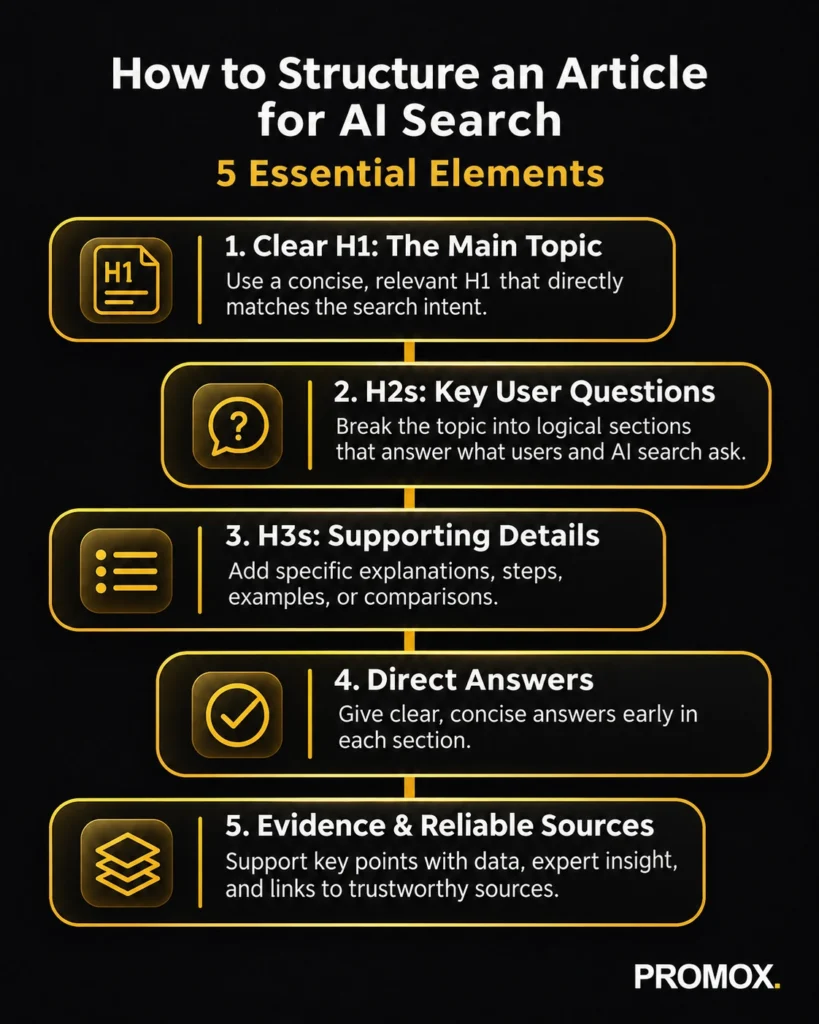
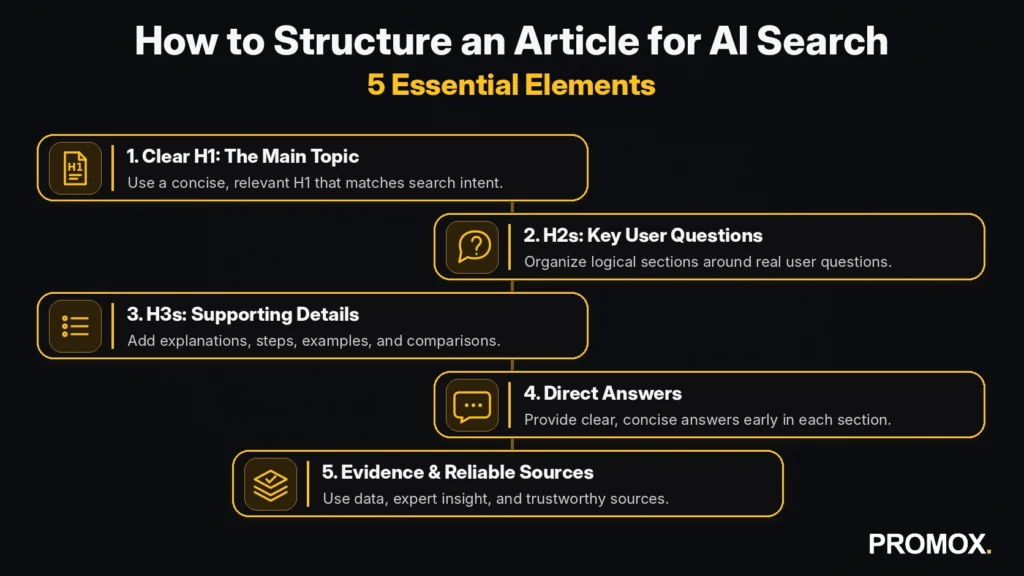
- One primary H1 heading.
- H2 headings covering important questions.
- H3 subheadings for details and examples.
- Informative paragraphs with clear ideas.
- Tables, instructions, and lists where appropriate.
Every section should serve a clear purpose.
However, there is no universal requirement to make paragraphs the same length. Content structure should primarily help users understand the information.
Lack of Specific Information
An article may contain numerous statements that sound correct but provide little practical value.
For example:
“High-quality content helps businesses improve their digital marketing performance.”
This statement offers limited guidance.
A more useful alternative would be:
“When auditing a page for technical SEO, check URL indexability, canonical tags, robots.txt directives, HTTP responses, and the accessibility of the main page content.”
The second version gives readers a practical set of actions.
Expert content becomes more valuable when it includes examples, explanations, supporting evidence, and actionable recommendations.
Outdated Information
Generative search technologies evolve, and advice published several years ago may no longer reflect current platform capabilities.
Content covering search crawlers, AI interfaces, analytics tools, structured data, and indexing requirements should be reviewed regularly.
Updating an article should involve verifying the actual information rather than simply changing its publication date.
Missing or Unreliable Sources
Articles about AI SEO frequently include impressive statistics without references to credible research.
Examples include claims of guaranteed citation growth after implementing Schema.org or fixed percentages of additional traffic from AI search.
Such statements should not be published without supporting evidence.
When presenting statistics, identify the original source, research period, sample size, and any relevant limitations.
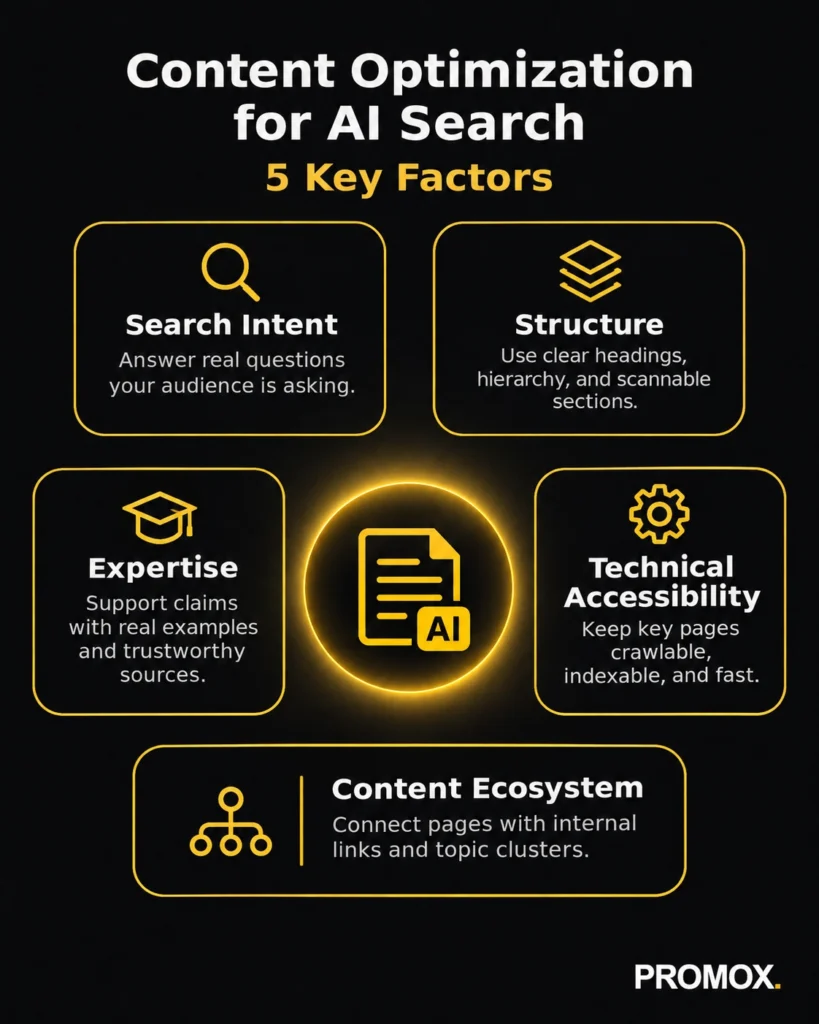
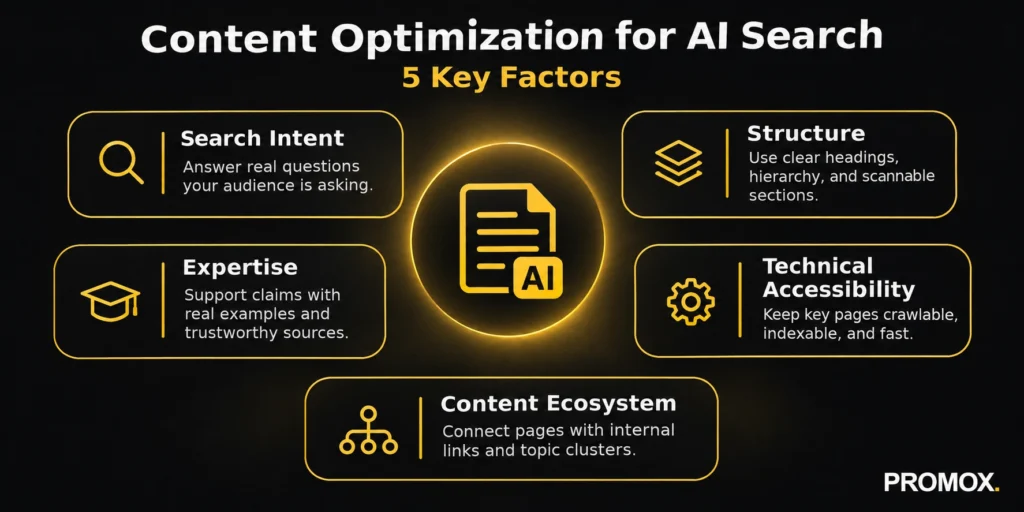
Weak Topical Connections Across the Website
A single article may cover one topic effectively without addressing the related questions visitors are likely to have.
This is why building topical content clusters and connecting them through relevant internal links is useful.
For example, an article about AI SEO can link to dedicated resources about ChatGPT Search, Google AI Overviews, technical SEO, and AI search analytics.
This architecture helps visitors explore subjects in greater depth and improves navigation across the website.
How to Optimize Content for AI Search in 2027: 10 Practical Steps
Effective AI search optimization begins with understanding the target audience and evaluating the technical condition of a website.
The next steps involve improving content quality, information structure, and performance measurement.
Step 1. Research Your Audience’s Real Questions
A successful content strategy should begin with user search intent.
Do not limit your research to high-volume keywords. Explore the problems people want to solve and the follow-up questions they ask when researching products or services.
For example, a digital marketing agency may target questions such as:
- How can I optimize my website for ChatGPT Search?
- How do I optimize content for Google AI Overviews?
- What is the difference between GEO and traditional SEO?
- How can I measure brand visibility in AI search?
- Which technical settings affect AI search accessibility?
- How do I choose an AI SEO agency?
These questions can be grouped according to user intent: informational, comparative, practical, and commercial.
The structure of an article should reflect the primary search intent, while supporting sections should address closely related questions.
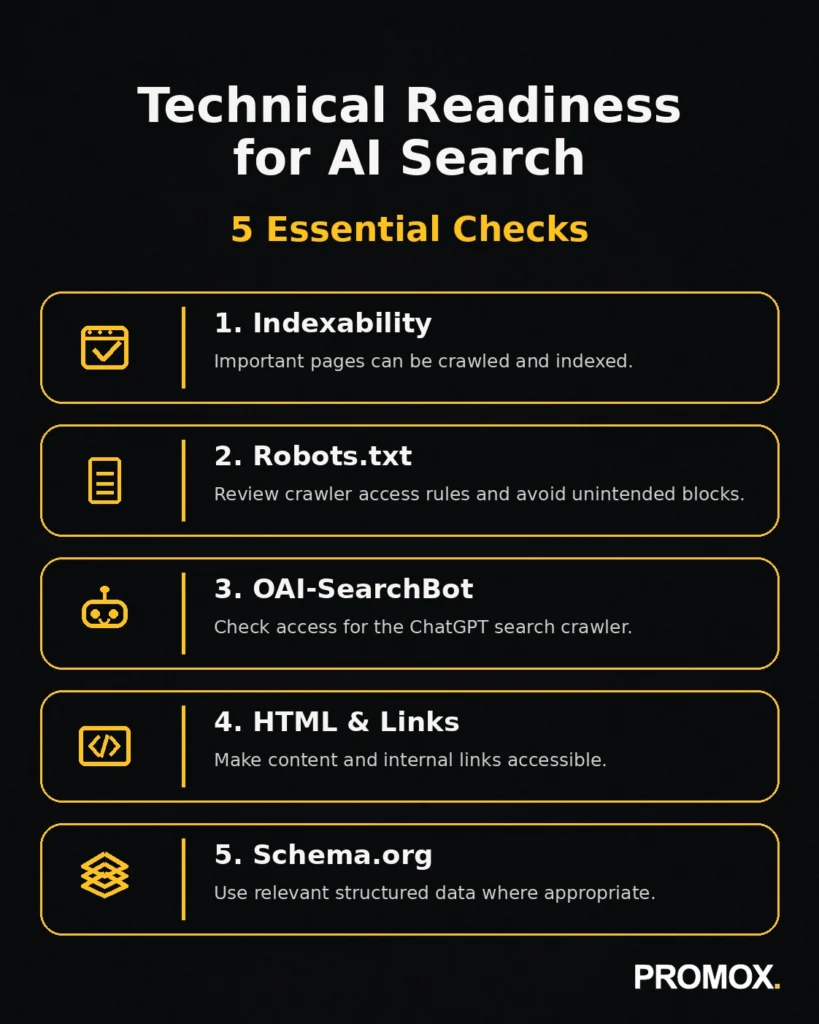
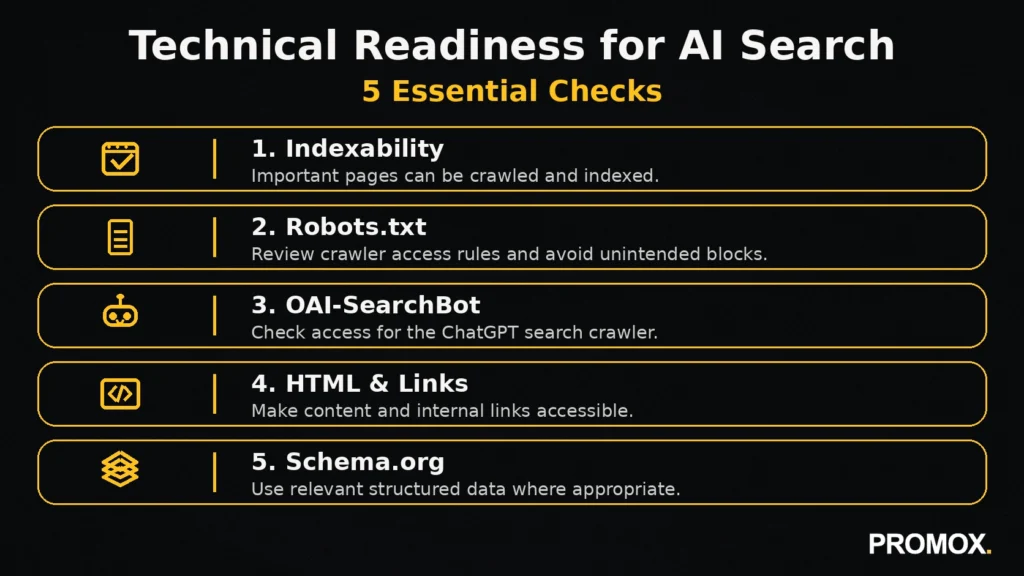
Step 2. Check Website Technical Accessibility
Even useful content may have limited search visibility because of technical problems.
Before optimizing the text itself, examine indexability, page accessibility, and server configuration.
Pay particular attention to:
- The
robots.txtfile. noindexdirectives.- HTTP status codes.
- Canonical URLs.
- XML sitemaps.
- Internal links.
- Mobile usability.
- Accessibility of the main page content.
For Google, pages generally need to be indexed and eligible to appear in Search with a snippet to participate in its generative search features.
If your website runs on WordPress, also check search engine visibility settings and your SEO plugin configuration.
Step 3. Configure Access for OpenAI Search Crawlers
For visibility in ChatGPT Search, website owners should understand the access requirements of OpenAI’s search crawlers.
OAI-SearchBot is associated with ChatGPT search functionality.
GPTBot serves a different purpose related to potential model training. These crawlers should not be treated as interchangeable.
An example rule allowing access to the search crawler is:
User-agent: OAI-SearchBot
Allow: /
However, this rule should not be added without reviewing the website’s existing configuration.
Other robots.txt rules, server restrictions, and CDN security settings must also be considered.
Even properly configured crawler access does not guarantee that a particular webpage will be cited in ChatGPT Search.
Step 4. Build Content Around Direct Answers
For informational content, it is useful to begin important sections with a clear answer to the user’s main question.
For example:
Is structured data required for AI SEO?
Structured data can help search engines interpret certain types of information and support specific search features. However, it is not a mandatory requirement for appearing in Google AI Overviews.
After providing this answer, the article can explain the purpose of different structured data types and show examples of implementation.
A useful information structure is:
Question → Direct Answer → Explanation → Example → Practical Takeaway.
This approach makes articles easier to navigate and helps explain complex topics without unnecessary digressions.
However, not every paragraph needs to be turned into a FAQ. The format should fit the content naturally.
Step 5. Publish Original, Expert-Led Content
One of the strongest advantages of a high-quality article is information that readers cannot find in dozens of nearly identical publications.
Examples include:
- Original research.
- Technical audit findings.
- Practical examples.
- Unique comparison tables.
- Detailed explanations of complex processes.
- Expert observations.
- Industry data with a transparent methodology.
For example, an article about search analytics becomes more useful when it demonstrates how to configure a specific report rather than simply advising readers to “track performance.”
When AI is used to assist with content creation, editorial review remains essential.
Facts, conclusions, terminology, and relevance should all be checked.
The objective is not to make an article merely appear human-written. It is to produce accurate, original, and genuinely valuable content.
Step 6. Implement Schema.org Structured Data
Structured data allows website owners to describe specific information about webpages in a standardized format.
For informational blogs, relevant Schema.org types may include:
Article.BlogPosting.Organization.Person.BreadcrumbList.
Other structured data types may be appropriate for pages with different content and purposes.
Three principles are particularly important.
First, structured data should accurately reflect information visible to users.
Second, select types and properties that genuinely match the page.
Third, do not treat structured data as a guarantee of rich results or AI citations.
Google does not require special Schema.org markup for participation in AI Overviews or AI Mode.
Step 7. Build Topical Content Clusters
Develop your website as an interconnected system of expert resources.
For example, a central topic could be “AI Search Optimization,” supported by more specialized content covering:
- Technical SEO.
- Content optimization.
- ChatGPT Search optimization.
- Google AI Overviews.
- Structured data.
- AI brand visibility measurement.
- GEO content strategy.
Each article should address a distinct question and naturally link to other relevant resources.
Avoid publishing large numbers of nearly identical pages solely to target slight variations of search queries.
The objective is not to maximize page count but to provide comprehensive and useful topical coverage.
Step 8. Strengthen Brand Authority and Transparency
Businesses benefit when expert content is connected to genuine professional experience and demonstrable expertise.
Include author information, reference credible sources, publish verifiable case studies, and maintain accurate descriptions of products and services.
When an article is written by a specialist, briefly explain their relevant background.
When research findings are presented, describe the methodology.
When discussing a client project, avoid attributing results that cannot be verified.
Trust is built through consistency, transparency, and supporting evidence rather than repeated claims of expertise.
Step 9. Optimize for Google AI Search and ChatGPT
Although the principles of high-quality content are broadly similar, individual platforms have their own characteristics.
Google AI Overviews and AI Mode
Google continues to emphasize indexability, useful original content, and compliance with its general search guidelines.
A separate “secret” markup format is not required for generative search visibility.
ChatGPT Search
Relevant content should be accessible to OpenAI’s search systems and provide accurate, useful information that matches user intent.
Whether a page is cited depends on the particular search experience and cannot be guaranteed.
International AI Search Visibility
Businesses operating internationally should consider language, location, audience expectations, and differences between markets.
A multilingual content strategy should involve meaningful localization rather than mechanical keyword translation.
Examples, terminology, pricing information, and search intent may vary from one country to another.
Step 10. Measure AI Search Visibility and Business Outcomes
AI search optimization requires a broader set of performance indicators than rankings alone.
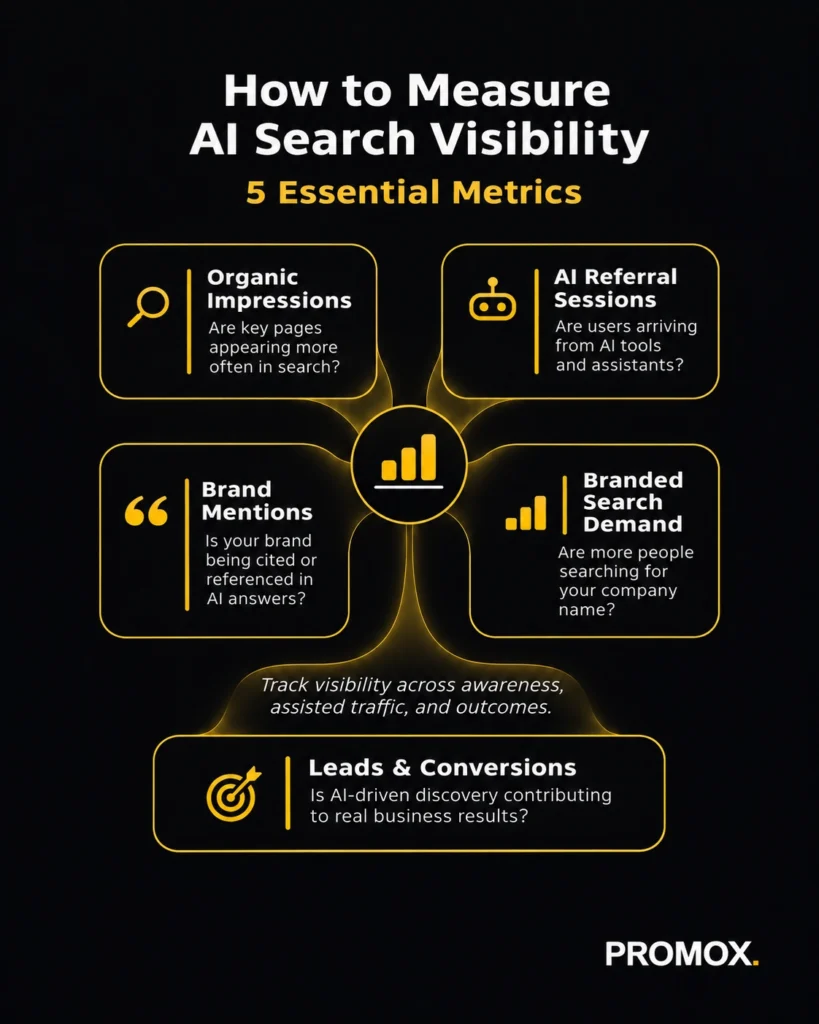
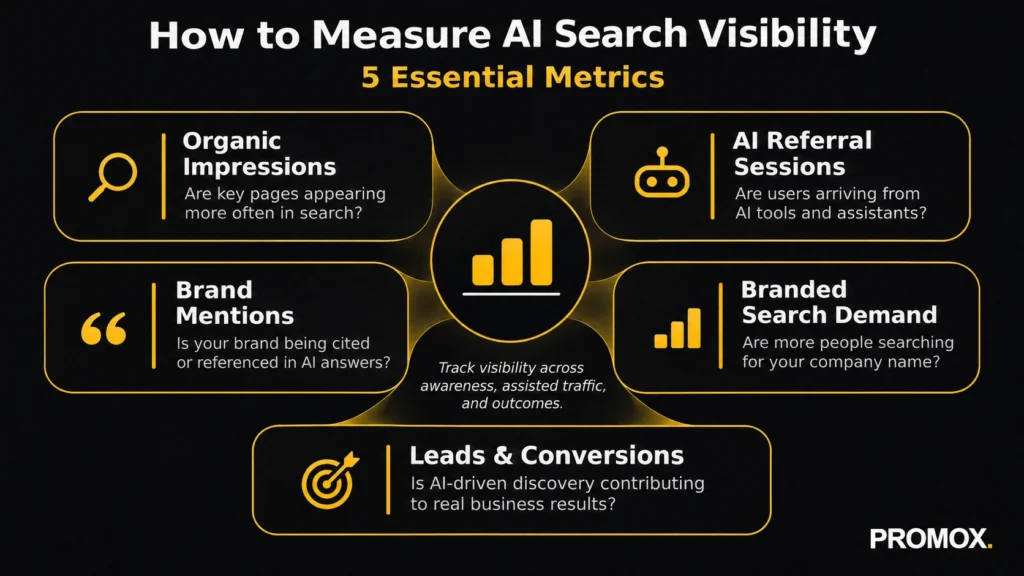
Important metrics include:
AI Visibility — the presence of a brand in responses generated by AI search systems.
Citation Frequency — how often a website appears as a cited source.
Share of Voice — a brand’s share of visibility compared with competitors across a defined set of queries.
AI Referral Traffic — identifiable website visits originating from AI-powered services.
Conversions — leads, inquiries, purchases, or other business outcomes associated with measurable traffic sources.
For monitoring, create a consistent set of relevant queries and regularly examine which brands and sources appear in AI-generated answers.
However, these findings should be interpreted carefully.
Generative responses can vary over time and according to user context. Not every brand mention leads to a website visit, and not every visit results in a conversion.
How to Optimize Content for Google AI Overviews in 2027
Google AI Overviews is a generative search feature that can provide concise or detailed answers while linking to additional sources.
Website optimization should focus on established SEO fundamentals.
Pages need to be technically accessible, provide useful information, and address genuine user needs.
Important practices include:
- Publish original content with specific explanations.
- Maintain technical accessibility and indexability.
- Use clear headings and relevant internal links.
- Verify facts and keep information current.
- Implement appropriate structured data.
- Avoid mass-producing low-value content.
- Analyze search performance in Google Search Console.
Do not assume that adding FAQs, lists, or a specific number of keywords guarantees inclusion in AI Overviews.
Generative search responses are determined by the query and the search system’s own processes.
How to Optimize Your Website for ChatGPT Search
Optimizing for ChatGPT Search begins with making information accessible and publishing resources that help answer user questions.
Business websites should provide detailed, accurate information about their services, expertise, products, and the problems they solve.
For example, a digital marketing agency can develop dedicated expert content about international SEO, GEO, analytics, technical optimization, and industry-specific marketing strategies.
Descriptions should remain factual.
Avoid unsupported statements such as “the world’s best agency” or “guaranteed first place in ChatGPT.”
Also verify access for OAI-SearchBot, review internal navigation, and identify potential technical barriers.
Evaluate performance using a combination of identifiable brand mentions, citations, referral traffic, and business conversions.
How to Use AI for SEO Content Creation
Artificial intelligence can accelerate content production, but it does not replace a comprehensive editorial process.
AI tools can assist with:
- Researching topics and planning content.
- Developing article outlines.
- Preparing initial drafts.
- Identifying missing explanations.
- Generating relevant questions.
- Improving content organization.
- Reviewing writing clarity.
However, information concerning technical configurations, statistics, legal requirements, and platform capabilities should be verified using reliable sources.
One particularly serious risk is publishing AI-generated claims supported by nonexistent studies or fabricated statistics.
When preparing expert content, it is important to verify facts, review primary sources, remove repetition, add original insights, evaluate search intent, and complete a final editorial review.
The value of an article depends on the quality of the final publication, not simply on whether AI was used during the drafting process.
How Often Should AI Search Content Be Updated?
There is no universal content update schedule.
Articles explaining relatively stable concepts may remain accurate for long periods. Resources covering rapidly changing platforms and tools require more frequent review.
For AI SEO guides, it is sensible to periodically revisit information about indexing, search crawlers, generative features, and analytics tools.
During an update, check:
- Technical instructions.
- Broken or outdated links.
- Platform interface changes.
- Statistical accuracy.
- Current official documentation.
- Completeness of answers to important user questions.
If substantial changes have been made, the article can display an updated publication date.
However, changing the year in a headline without improving the information does not make the content more valuable.
AI Search Content Optimization Checklist
Before publishing an expert article, conduct a comprehensive quality review.
Technical optimization: The page is indexable, important content is accessible, the server responds correctly, and relevant search crawlers are not unintentionally blocked.
Content quality: The article solves a specific problem, answers the primary query, provides clear explanations, and avoids superficial statements.
Structure: Headings are logical, sections follow a coherent sequence, and tables or lists are used where they improve understanding.
Accuracy: Statistics are verified, sources are identified, examples are genuine, and information is current.
Authority: Authorship, company expertise, and the basis for professional recommendations are transparent.
Internal linking: The article connects naturally to related pages and resources.
Mobile usability: The page is readable on mobile devices, navigation works properly, and important elements do not obstruct content.
Analytics: Search performance and identifiable AI referral traffic can be monitored alongside business outcomes.
This checklist does not guarantee inclusion in AI-generated responses, but it helps address many issues that website owners can directly control.
Frequently Asked Questions About AI Search Content Optimization
What Is AI SEO in Simple Terms?
AI SEO is the process of optimizing websites for search experiences powered by artificial intelligence. It aims to make content more accessible, useful, and understandable for search systems that can generate answers to user questions.
How Can My Website Appear in ChatGPT Search Results?
Publish relevant and trustworthy information, ensure your important pages are technically accessible, and review access settings for OAI-SearchBot. However, no optimization method can guarantee that a particular website will be cited in ChatGPT Search.
Is Schema.org Required for AI Search?
Structured data can help describe webpage content and support certain search features. However, it is not a mandatory requirement for appearing in Google AI Overviews.
Do Keywords Matter for AI Search Optimization?
Keywords remain useful for defining topics and matching search intent. However, repeating keywords does not replace high-quality content, technical accessibility, and a clear information structure.
What Is the Difference Between GEO and SEO?
SEO covers a broad range of activities intended to improve website visibility in search engines. GEO focuses on the visibility of content and brands within generative search systems. In practice, the two approaches are closely connected.
Can ChatGPT Be Used to Write SEO Articles?
Yes. AI can support research, outlining, drafting, and editing. However, the final content should be accurate, original, useful, and reviewed for quality. Mass-producing low-value content primarily to manipulate search rankings can violate Google’s spam policies.
How Can I Measure AI Search Visibility?
Track brand mentions, citations, share of voice across relevant prompts, identifiable AI referral traffic, and business conversions. Use consistent monitoring methods and interpret results alongside traditional search analytics.
How Long Does AI Search Optimization Take?
The timeline depends on the website’s current condition, competition, the scope of optimization, and how quickly search systems process changes. There is no guaranteed period after which citations or traffic improvements will occur.
Will Traditional SEO Still Matter in 2027?
Yes. Indexability, technical SEO, content relevance, internal linking, and information quality remain essential foundations of search visibility, including many generative search experiences.
Conclusion
In 2027, optimizing content for AI search is becoming an increasingly important part of a comprehensive organic search strategy.
Businesses need to consider not only their rankings in Google but also the ways users discover information through ChatGPT, Google AI Overviews, and Google AI Mode.
However, effective optimization is not about guessing hidden algorithms or attempting to manipulate AI-generated answers.
Its foundations remain clear: technically accessible websites, well-organized information, expert content, trustworthy sources, regular updates, and systematic performance measurement.
Content should answer real audience questions, help users make informed decisions, and provide information they can rely on.
The ultimate goal of AI SEO is not simply to have a brand mentioned in an AI-generated response. It is to transform search visibility into brand awareness, qualified traffic, and measurable business growth.
At PROMOX, we view AI search optimization as a natural evolution of modern SEO strategy. By combining technical optimization, expert content, search analytics, and brand authority development, businesses can build a stronger and more sustainable presence across emerging search experiences.
If you want to prepare your website for the changing search landscape of 2027, connect with PROMOX to identify the opportunities that can deliver the greatest value for your business.
Frequently Asked Questions About AI Search Content Optimization in 2027
What Is Content Optimization for AI Search?
Content optimization for AI search is the process of preparing website content to be discovered, understood, and potentially used by AI-powered search engines. It involves creating useful, accurate content, improving page structure, ensuring technical accessibility, strengthening internal linking, and demonstrating expertise. This approach builds on traditional SEO while adapting content for search experiences such as ChatGPT Search, Google AI Overviews, and Google AI Mode.
How Do You Optimize Content for AI Search in 2027?
Start by researching your audience’s questions and search intent. Next, verify page indexability, organize content using a logical H1–H3 heading structure, and provide direct answers to important questions. Include practical examples, reliable sources, and relevant internal links. Keep information accurate and up to date, and monitor performance through search analytics. The primary goal is to create content that genuinely helps users rather than simply repeating target keywords.
How Should You Structure an Article for AI Search Engines?
Use one main H1 heading, H2 headings for key topics or questions, and H3 subheadings for supporting explanations. Each section should address a clear subject. Begin important sections with a direct answer, followed by supporting details, examples, and actionable recommendations. Tables, lists, and concise definitions can make information easier to navigate. However, search engines do not require a fixed paragraph length or a specific word count for every section.
How Can You Make Content More Suitable for ChatGPT Search?
Publish accurate, original, and well-structured information that answers specific user questions. Ensure important pages are accessible to OAI-SearchBot and are not unintentionally blocked by robots.txt rules, server settings, or CDN security restrictions. Support your content with expert explanations, current information, and relevant internal links. These practices improve the conditions for content discovery, but they do not guarantee that a website will be cited in ChatGPT Search responses.
How Do You Optimize an Article for Google AI Overviews and AI Mode?
Follow Google’s established SEO best practices: ensure pages can be indexed, publish helpful and original content, and maintain technical accessibility. Articles should match user search intent, provide reliable information, and offer a clear reading experience. Relevant internal links and accurate structured data can support general SEO. Google does not require special AI-specific markup or a separate content format for participation in AI Overviews or AI Mode.
Is Schema.org Structured Data Required for AI Search Optimization?
Schema.org structured data can help search engines interpret specific information about a webpage. For editorial content, relevant types may include Article and BlogPosting, while BreadcrumbList can describe website navigation. However, structured data does not guarantee inclusion in ChatGPT Search or Google AI Overviews. Markup should accurately represent the content visible on the page and follow the applicable guidelines of each search platform.
Do Keywords Still Matter for AI Search Content Optimization?
Keywords remain useful for defining a page’s topic and matching user search intent. However, keyword repetition alone does not guarantee higher rankings or citations in AI-generated answers. Effective content should address the user’s actual question, cover closely related topics, use natural terminology, and provide practical value. The completeness, accuracy, and usefulness of an answer matter more than repeating an exact keyword a certain number of times.
Can You Use ChatGPT to Create SEO Content in 2027?
Yes. AI tools such as ChatGPT can assist with topic research, content planning, outlining, drafting, and editorial review. However, the final article should be checked for factual accuracy, reliable sources, relevance, and originality. Using AI does not automatically reduce a page’s ability to rank. The main risks arise from publishing large volumes of low-value, inaccurate, or unoriginal content primarily designed to manipulate search rankings.
How Does Internal Linking Help with AI Search Optimization?
Internal linking connects related content, helps users discover additional information, and supports search crawlers in finding relevant pages. For example, a comprehensive AI SEO guide may link to resources about technical SEO, ChatGPT Search, Schema.org, and search analytics. A well-organized content structure also makes it easier for visitors to explore a topic in greater depth. Link relevance and navigation quality matter more than including a fixed number of internal links on every page.
How Often Should You Update Content for AI Search?
The appropriate update frequency depends on the topic and how quickly information changes. Articles about search crawlers, Google AI Overviews, ChatGPT Search, and analytics tools should be reviewed regularly because platform features and technical requirements may evolve. During updates, verify facts, references, technical instructions, and examples. Simply changing the publication date without improving the content does not make an article more useful or relevant.
How Do You Measure the Effectiveness of AI Search Content Optimization?
Measure performance using Google Search Console, website analytics, and consistent monitoring of AI-generated search responses. Track organic impressions and clicks, identifiable AI referral traffic, brand mentions, citations, and conversions. Additional metrics may include AI Visibility and Share of Voice across a defined set of relevant queries. Because AI responses may vary over time and according to user context, an individual citation should not be treated as proof of sustained visibility, traffic growth, or revenue.
Can You Guarantee That Your Content Will Appear in AI-Generated Answers?
No. There is no reliable way to guarantee that a particular article will appear in responses from ChatGPT Search, Google AI Overviews, or Google AI Mode. Source selection depends on the platform, the user’s query, content accessibility, and other factors. Effective optimization can help remove technical barriers, improve content quality, and strengthen a website’s readiness for AI-powered search. Results should be evaluated using measurable data rather than promises of guaranteed citations.